
Last updated October 2026 · By Walkers4Seniors Editorial Team
Affiliate disclosure: Some links on this page are affiliate links. If you buy through them, we may earn a small commission at no extra cost to you. Read our disclosure.
Medical disclaimer: This guide is general information, not medical advice. After hip or knee surgery, or if you are unsure which seat is safe, follow the advice of your surgeon, physical therapist or occupational therapist.
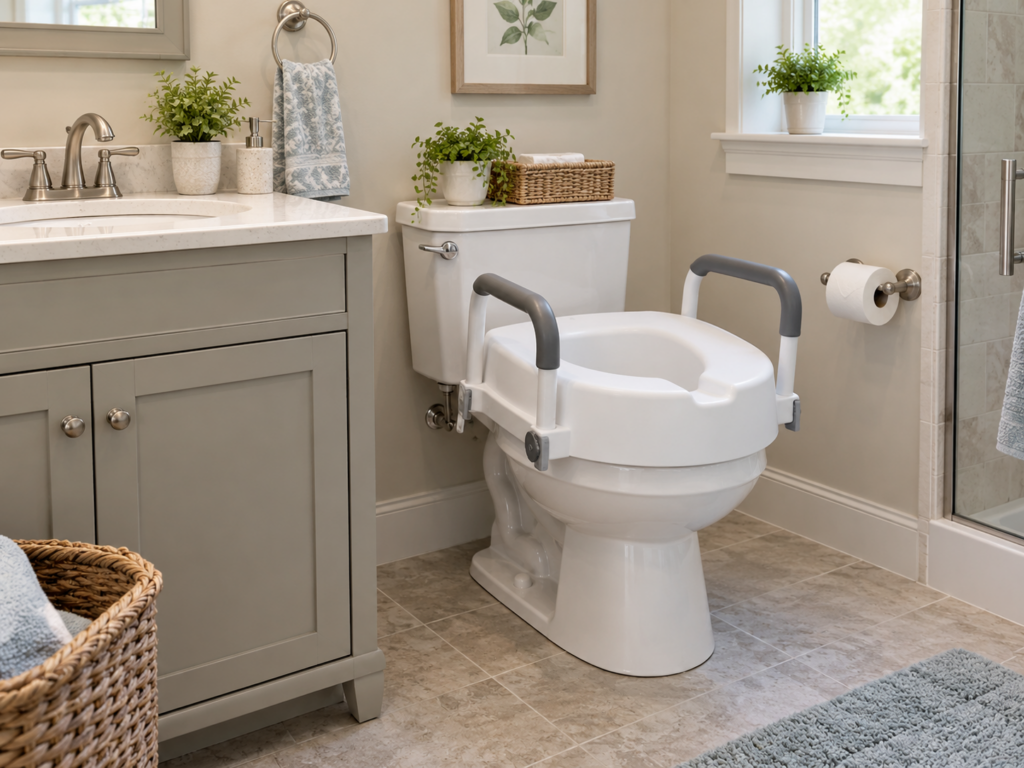
Quick answer: A raised toilet seat adds 3.5 to 5 inches of height so you bend less when sitting down and standing up. For most seniors, a locking seat with padded arms, such as the Carex E-Z Lock (5 inches, 300 lb), is the safest start. Check your bowl shape (round or elongated) and weight capacity before you buy.
Our Top Picks at a Glance
- Best with handles: Carex E-Z Lock Raised Toilet Seat with Handles – adds 5 in, 300 lb, adjustable removable padded arms. Buy direct from Carex.com ($42.40 in October 2026).
- Best for elongated toilets: Drive Medical Premium Elongated Raised Toilet Seat with Lock (12013) – adds 5 in, arms 21 in apart.
- Best heavy-duty: Drive Medical Raised Toilet Seat with Lock (12066 / 12065 with lid) – 400 lb capacity.
Need something that also works beside the bed at night? A 3-in-1 commode can stand over the toilet as a raised seat with arms. Compare models in our guide to the best bedside commodes for seniors.
Raised Toilet Seats Compared
| Product | Height added | Weight capacity | Toilet shape | Arms | How it attaches |
|---|---|---|---|---|---|
| Carex E-Z Lock with Handles | 5 in | 300 lb | Best on round (owners report slipping on elongated) | Padded, adjustable, removable | Locks onto the bowl |
| Drive Premium Seat Riser with Removable Arms (12402 / 12403) | 3.5 in | 300 lb | 12402 round; 12403 elongated | Removable, 19.75 in apart | Bolts on in place of your seat |
| Vive Health Toilet Seat Riser with Arms (LVA1071S / LVA1071E) | 3.5 in | 300 lb | Round (S) or elongated (E) | Removable, 19 in apart, 9.5 in above rim | Bolts on in place of your seat |
| Drive Premium Elongated Raised Seat with Lock (12013 arms / 12014 no arms) | 5 in (12013) | 300 lb | Elongated | 12013: 21 in apart | Locks onto the bowl |
| Drive Raised Toilet Seat with Lock (12066 / 12065 with lid) | Check listing | 400 lb | Most toilets | None | Worm-screw locking plate |
| Carex Toilet Seat Riser | 5 in | 300 lb | Round and elongated | None | Sits on bowl, anti-slip pads |
| Drive Toilet Safety Frame (RTL12000) – not a seat | 0 in (arms only) | 300 lb | Most toilets | Padded, 28-32 in high, 19-23.5 in apart | Bracket under the toilet seat bolts |
Specs are from manufacturer and retailer listings checked in October 2026. Models change, so confirm height, capacity and bowl fit on the listing before you order.
Why Do Seniors Need a Raised Toilet Seat?
A raised toilet seat lifts you higher, so your hips and knees bend less when you sit and stand. That makes the move easier for people with weak legs, arthritis, back pain or a new hip or knee.
The bathroom is a common place to get hurt. A CDC study found that an estimated 234,094 people aged 15 and older were treated in U.S. emergency departments for bathroom injuries in 2008. Falls caused 81.1% of them. (CDC MMWR, 2011)
Risk climbs with age. The injury rate was 112.1 per 100,000 at ages 65-74 and 515.3 per 100,000 at 85 and older. Among people 85 and older, 51.7% of bathroom injuries happened at or near the toilet.
Not sure how high your fall risk is? Try our free fall risk self-check.
How High Should a Raised Toilet Seat Be?
The seats on this page add 3.5 or 5 inches. The right height lets you sit with your feet flat on the floor and your knees no higher than your hips.
For comparison, the ADA standard for accessible toilets sets seat height at 17 to 19 inches from the floor to the top of the seat (2010 ADA Standards, 604.4).
How to measure in 2 minutes
- Sit on a firm chair with your feet flat. Measure from the floor to the crease behind your knee.
- Measure your toilet from the floor to the top of the seat.
- The difference is roughly the height you need to add. If it falls between sizes, ask your therapist which to choose.
After hip replacement: many surgeons give hip precautions such as keeping your knees lower than your hips and not sitting on a low toilet. One surgical group’s handout tells patients to “use a raised toilet seat” (Proliance Surgeons hip precautions, 2023). Your own surgeon’s instructions come first.
Raised Toilet Seat vs Toilet Safety Frame: Which Do You Need?
- Raised seat: adds height. Best when the toilet is too low and bending is the main problem.
- Safety frame: adds arms to push on, but no height. Best when the height is fine but you need support to stand.
- Raised seat with arms: adds both. This is the usual choice for seniors with weak legs or after surgery.
If a grab bar can be installed in the wall next to the toilet, the CDC study above lists toilet grab bars as an option “for added support if needed.”
The 7 Options in Detail
1. Carex E-Z Lock Raised Toilet Seat with Handles – Best With Handles
Manufacturer specs: adds 5 inches; 300 lb capacity; padded arms that adjust and remove.
What owners report: on Walmart it holds 4.2 of 5 stars from 592 ratings (October 2026). Several reviewers say it locks well on round bowls but can slide on elongated bowls.
Who it is NOT for: people with an elongated toilet who want a locked fit, or anyone over 300 lb.
2. Drive Medical Premium Seat Riser with Removable Arms (12402 / 12403) – Best Value Bolt-On
Manufacturer specs: adds 3.5 inches; 300 lb capacity; seat 17 x 13.75 in; 19.75 in between arms; weighs 3.5 lb; arms remove without tools. It bolts on in place of your regular seat. Carewell listed the round model at $45.05.
Who it is NOT for: people who need more than 3.5 inches of lift, or households where others want the regular seat back each day.
3. Vive Health Toilet Seat Riser with Arms (LVA1071S / LVA1071E)
Manufacturer specs: adds 3.5 inches; 300 lb capacity; standard (round) or elongated versions; handles sit 9.5 in above the rim and 19 in apart; handles remove with locking pins. Listed at $74.99 (MDMaxx, October 2026).
Who it is NOT for: very wide users who need more room between handles, or anyone who needs a 5-inch lift.
4. Drive Medical Premium Elongated Raised Toilet Seat with Lock (12013 / 12014) – Best for Elongated Toilets
Manufacturer specs: made for elongated bowls; 300 lb capacity; locking mechanism. Model 12013 adds 5 inches and has arms 21 in apart. Model 12014 has no arms (4.5 in seat height).
Who it is NOT for: round toilets.
5. Drive Medical Raised Toilet Seat with Lock (12066 / 12065 with lid) – Best Heavy-Duty
Manufacturer specs: 400 lb capacity; molded plastic; worm-screw locking plate for a secure fit; 14 x 16 in seat; limited lifetime warranty. The listing we checked did not state the height added, so confirm it before you buy.
Who it is NOT for: anyone who needs arms to push up from (pair it with a safety frame or grab bar).
6. Carex Toilet Seat Riser – Simplest, No Arms
Manufacturer specs: adds 5 inches; 300 lb capacity; fits standard round and elongated toilets; anti-slip pads underneath; 5 x 15 x 16 in.
Who it is NOT for: people who need something to push on when standing.
7. Drive Medical Toilet Safety Frame (RTL12000) – Arms Without Height
Manufacturer specs: padded arms adjust from 28 to 32 inches high in 1-inch steps; two widths, 19 to 23.5 in between arms; 300 lb capacity; 4 lb; attaches with a bracket under the toilet seat bolts.
Who it is NOT for: people whose main problem is a toilet that is too low.
How to Choose the Right Raised Toilet Seat
- Bowl shape: measure from the seat bolts to the front of the bowl. About 16.5 in usually means round; about 18.5 in usually means elongated.
- Height: use the 2-minute measurement above.
- Arms: choose arms if standing up is hard. Check the width between arms against the user’s hips.
- Weight capacity: most seats are rated 300 lb; choose a 400 lb model if needed.
- Attachment: bolt-on and locking seats move less than seats that only sit on the bowl.
- Cleaning: one-piece molded plastic is easiest to wipe down.
Using a Raised Toilet Seat With a Walker
- Walk forward to the toilet, then turn until your back faces it.
- Back up until you feel the seat against the back of your legs.
- Reach back for the seat arms or grab bar one hand at a time. Do not lean on a rolling walker to sit or stand, because it can roll away.
- Lower yourself slowly. To stand, push up from the arms, then take hold of the walker.
A narrow bathroom door can make this harder. See our guide to narrow walkers for small spaces and these common walker safety mistakes.
Who a Raised Toilet Seat Is NOT For
- People who cannot sit safely without full trunk support. Ask an occupational therapist about a commode chair.
- Anyone who cannot reach the bathroom in time at night. A bedside commode may be safer.
- Users over a seat’s rated weight capacity.
- Seats that only sit on the bowl, for people who shift their weight a lot. Choose a locking or bolt-on model.
Does Medicare Pay for a Raised Toilet Seat?
No. Original Medicare does not cover raised toilet seats. The CGS Medicare DME policy states that “a raised toilet seat (E0244), either attached or unattached, is non-covered.” A commode chair placed over the toilet as a raised seat is also not covered. (CGS Medicare, Commodes policy)
Some Medicare Advantage plans offer extra home-safety benefits, so ask your plan. Learn more in our Medicare guide for walkers and rollators.
More Ways to Make the Bathroom Safer
- Add grab bars next to the toilet and in the shower, and non-slip strips in the tub (CDC MMWR recommendations).
- Light the path to the bathroom at night. See where seniors fall most often at home.
- Consider a medical alert system that works in the bathroom.
- Check balance with the Timed Up and Go test.
- For getting in and out of bed, see our bedside step stool guide.
Shop toilet grab bars on Amazon
Frequently Asked Questions
How high should a raised toilet seat be for a senior?
Common sizes add 3.5 to 5 inches. Pick the height that lets you sit with feet flat and knees no higher than your hips. For reference, ADA accessible toilets are 17 to 19 inches high to the top of the seat.
Does Medicare cover raised toilet seats?
No. Original Medicare lists raised toilet seats (HCPCS E0244) as non-covered, whether attached or unattached. Some Medicare Advantage plans may offer extra benefits, so check with your plan.
Are raised toilet seats safe?
They are safe when they fit your bowl and are locked or bolted in place. Seats that only sit on the bowl can shift. Check the fit before each use and stay within the weight limit.
Will a raised toilet seat fit an elongated toilet?
Only if the model is made for elongated bowls or lists both shapes. Measure from the seat bolts to the front of the bowl: about 18.5 inches usually means elongated.
What is the difference between a raised toilet seat and a toilet safety frame?
A raised seat adds height. A safety frame adds arms to push on but no height. A raised seat with arms gives both.
Do I need a raised toilet seat after hip replacement?
Many surgeons recommend one, because hip precautions often say to keep your knees lower than your hips and avoid low toilets. Follow your surgeon’s specific instructions.
Sources
- Stevens JA, Haas EN, Haileyesus T. Nonfatal Bathroom Injuries Among Persons Aged 15 Years or Older – United States, 2008. MMWR 2011;60(22):729.
- CGS Medicare (DME MAC Jurisdiction B). Commodes – coverage policy summary.
- U.S. Access Board. 2010 ADA Standards for Accessible Design, 604.4 Seats.
- Proliance Surgeons. Precautions for Posterior Total Hip Replacement (rev. 2023).
- Product specs: Carex E-Z Lock (Walmart); Drive 12402 (Carewell); Vive LVA1071E (MDMaxx); Drive 12013/12014; Drive 12066 (MDMaxx); Drive RTL12000.
We did not test these products hands-on. Picks are based on manufacturer specifications, retailer listings and published owner ratings, checked October 2026.