
More Than a Step: 7 Surprising Mistakes That Turn Your Walker into a Hazard
Introduction: The Paradox of the Helping Hand
Walker safety mistakes can turn a mobility aid into a hazard. For many, a walker is more than a medical device; it is a passport to independence. It is designed to be the ultimate safety net, providing a stable foundation when balance or strength is compromised. However, there is a hidden epidemic of walker-related trips and falls caused by a misunderstanding of the invisible physics of the aluminum frame.
Using a walker may seem as simple as pushing it forward, but safe navigation requires a deep respect for body mechanics. When we ignore the clinical precision required for its setup and use, we turn a helping hand into a significant hazard. To move with genuine confidence, we must treat the walker not as a piece of luggage we are pushing, but as a clinical extension of our own skeleton. Learn more about choosing the right walker for your need.
Mistake #1: The “Wrist Rule” and the Height Trap
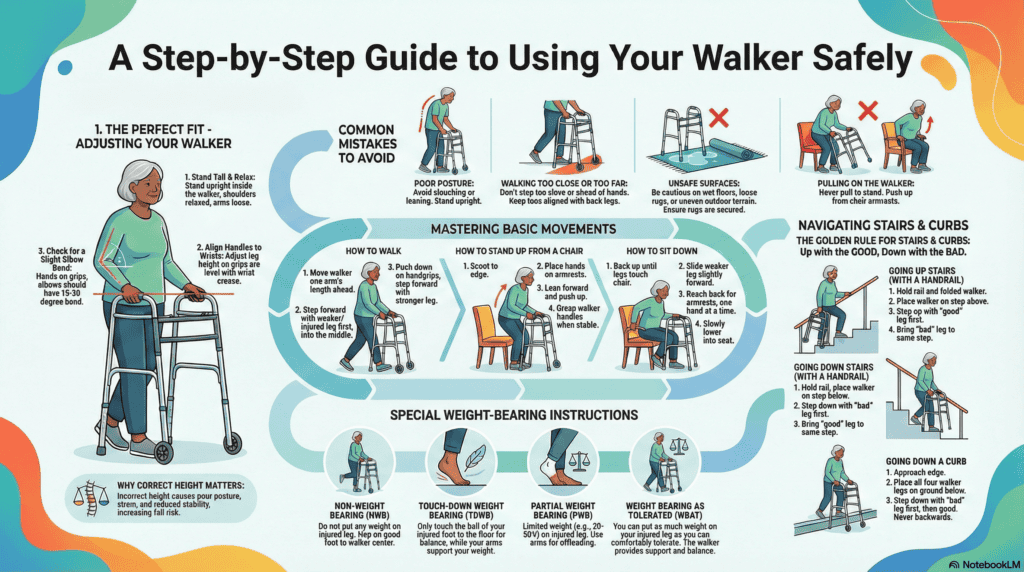
The most common error in mobility begins before you take a single step. A walker adjusted to the wrong height forces the body into a “proprioceptive trap.” If it is too low, you are lured into a stooped posture that strains the back; too high, and you experience chronic neck and shoulder fatigue.
The Actionable Fix: Stand as upright as possible with your shoulders relaxed and arms hanging naturally at your sides. The hand grips of the walker must align perfectly with the crease of your wrist. When you grasp the handles, your elbows should maintain a slight bend of 15 to 20 degrees.
This specific angle is not arbitrary; it is a mechanical necessity. A 15–20 degree bend allows for optimal tricep leverage, giving you the necessary power to support your body weight through your arms. This small adjustment fundamentally stabilizes your center of gravity, allowing you to stand tall rather than leaning precariously.
“Poor posture, leading to back, shoulder, and wrist strain… [can cause] inefficient walking patterns, causing fatigue.”
Mistake #2: Using the Walker as a Pull-Up Bar
When rising from a chair, the natural instinct is to reach forward and grab the walker to pull yourself up. This is a dangerous miscalculation of physics. Walkers are engineered to withstand downward pressure, not horizontal pulling forces. Because they are lightweight and often wheeled, pulling on the frame can cause the device to topple toward you or roll away.
The Actionable Fix: To stand safely, scoot to the edge of your seat. Place your hands on the armrests of the chair and push straight up. Only once you are fully upright and have checked your balance should you reach for the walker handles.
Conversely, when sitting, never “plop” into the seat. Back up until you feel the chair against the back of your legs, reach back for the armrests with at least one hand (ideally both), and lower yourself slowly and controlled.
“The walker is too unstable to hang onto when getting up or down – so use the chair armrests instead.”
Mistake #3: The “Toes-to-Bar” Error
A leading cause of backward falls is standing in the wrong “stepping zone.” Many users either reach too far ahead or, more commonly, crowd the front bar. If your feet get ahead of your hands, you lose your vertical stability and risk tipping the frame or falling backward.
The Actionable Fix: Think of the space between the back legs of the walker as your “safety box.” When advancing the device, move it forward about an arm’s length, ensuring the back legs of the walker are at least at your toe level. Step into the center of the frame with your weaker leg first, followed by your stronger leg, but never let your toes get closer than six inches to the front bar.
“You never need to get closer than six inches to the front walker bar – if you get too close and your legs get ahead of your hands, you may lose your balance and fall backwards.”
Mistake #4: Watching Your Feet, Not the Horizon
When balance feels insecure, our instinct is to “visually confirm” every step by looking down. However, this creates a dangerous postural shift. Looking down slumps the shoulders and, more importantly, suppresses the vestibular system’s ability to maintain balance by shifting the head posture, which is the body’s primary reference for verticality.
The Actionable Fix: Keep your head up and your eyes on the horizon. Trust your peripheral vision to monitor the path immediately in front of you. Looking ahead allows you to proactively spot hazards—like loose rugs, pets, or cords—rather than reacting to them when it is too late to adjust your momentum.
Mistake #5: Misunderstanding the “Up with the Good, Down with the Bad” Rule
Navigating stairs or curbs is the most high-risk activity for walker users. A forward-facing approach on a standard staircase is inherently unstable. You must use specific techniques to maintain a three-point contact system.
The Actionable Fix: Always remember the mnemonic: “Up with the good, down with the bad.”
• To go up: Step up with your strong (good) leg first, then bring the walker and the weak leg up.
• To go down: Move the walker down first, step down with the weak (bad) leg, then bring the strong leg down.
The Clinical Technique: Never face forward on stairs with an open walker. Instead, use one of two methods:
1. The Sideways Method: Turn the walker sideways so the opening faces away from you. Place two legs on the step you are moving to and two legs on the step you are on. Hold the upper corner of the walker with one hand and a sturdy handrail with the other.
2. The Folding Method: Approach the stairs, fold the walker, and hold it in one hand while using the handrail with the other. Set the folded walker on the step first before moving your feet.
Mistake #6: The “Eggshell” Weight-Bearing Confusion
Following surgery, your doctor will prescribe a specific weight-bearing status. Misinterpreting these limits can lead to surgical failure or bone reinjury. A common point of confusion is “Touch Down Weight Bearing” (TDWB).
The Actionable Fix: If your doctor prescribes TDWB, you must limit the pressure on that limb to less than 10 pounds. Imagine you are “walking on eggshells”—the ball of your foot touches the floor only for balance, while your arms and the walker support nearly all of your weight. For Partial Weight Bearing (PWB), the limit is usually 30–50% of your body weight. Always follow the specific pound or percentage limit provided by your physician.
“First things first, know what your doctor feels is safe for you at this time… it is important that you follow your doctor’s orders and put only the amount of weight advised on your affected side.”
Mistake #7: Ignoring the “Indoor Only” Limitation
Standard walkers with small wheels or rubber tips are often defeated by common household and outdoor hazards. Indoor-only models are frequently tripped up by loose rugs, rug corners, and electrical cords. Furthermore, using an indoor walker on gravel, ice, or uneven pavement can cause the rubber tips to catch or wear down prematurely.
The Actionable Fix: Perform a “daily pre-flight check” on your equipment. Inspect the rubber tips for rips, tears, or smooth spots. A worn tip turns a stable tool into a slippery hazard. Ensure your home is clear of clutter and that all rugs are secured. If you frequently navigate outdoor terrain, consult a specialist about a walker with larger, all-terrain wheels designed for those surfaces.
Conclusion: Moving Forward with Confidence
Avoiding walker safety mistakes is essential for reclaiming your mobility safely. While these common errors are preventable, the right technique makes all the difference. Professional guidance from an Occupational Therapist is the gold standard for ensuring your walker is customized to your specific body mechanics and home environment.
Frequently Asked Questions About Walker Safety Mistakes
What are the most common walker safety mistakes?
The most common walker safety mistakes include: improper height adjustment, using the walker as a pull-up bar when standing, walking too close to the front bar, looking down at your feet instead of ahead, and ignoring indoor/outdoor limitations of your walker type.
How can I prevent walker safety mistakes?
To prevent walker safety mistakes: ensure proper height adjustment using the wrist-crease method, always use chair armrests when sitting/standing, keep the walker’s back legs at your toe level, look forward while walking, perform daily equipment checks, and use the appropriate walker type for your environment.
What happens if I ignore walker safety mistakes?
Ignoring walker safety mistakes can lead to falls, injuries, back and shoulder strain, surgical failure, bone reinjury, and reduced mobility. These common errors significantly increase your risk of walker-related accidents and can compromise your independence and recovery.