

We don’t sell walkers. walkers4seniors.com is reader-supported: when you buy through links on this site, we may earn a commission at no extra cost to you (affiliate disclosure). This guide is general information, not medical advice. Please check with your doctor or physical therapist before choosing a walker.
Finding the right walker can transform your independence and quality of life. Whether you’re recovering from hip surgery, managing arthritis, or simply need extra stability for daily activities, choosing the right mobility aid starts with understanding your specific needs and lifestyle.
This guide walks you through every main type, including standard walkers, rollators with seats, lightweight travel models, bariatric walkers for heavier users, narrow models for small apartments, upright walkers, and all-terrain options for outdoor use. For each one, we explain who it suits, who it doesn’t, and what to check before you buy.
How We Choose What to Recommend
We compare walkers using manufacturer specifications (weight, folded size, frame width, handle height range, weight capacity, and warranty), published guidance from trusted sources such as Medicare.gov, and patterns in verified customer reviews. We don’t run lab tests, and we never claim hands-on testing we haven’t done.
What You’ll Find on This Site:
- Plain-English comparisons organized by need, not by brand
- Sizing help, including our walker handle height calculator
- Guides for specific situations such as arthritis, Parkinson’s disease, and recovery after hip surgery
- Medicare and insurance basics, with links to official sources
- Safety and fall-prevention advice for seniors and caregivers
Walker Types for Every Lifestyle and Need
Walkers with Seats for Arthritis Patients
If you need frequent rest breaks, a rollator with a built-in seat lets you sit down wherever you are. Look for a padded seat and backrest, a storage basket, and hand brakes that are easy to squeeze with reduced grip strength. These work well for grocery shopping, walks in the park, and daily errands. See our guides to walkers for arthritis and the most comfortable rollator seats.
Lightweight Rollators for Travel
Many travel rollators weigh under 15 pounds and fold small enough for a car trunk or an airport gate check. Lighter frames are easier to lift, but check the weight capacity and seat width before you buy, since the lightest models can give up some stability. Compare options in our ultra-lightweight travel walkers guide.
Bariatric Walkers for Heavy Seniors
Standard walkers and rollators are usually rated for about 250 to 300 pounds. Bariatric (heavy-duty) models use reinforced frames, wider seats, and wider bases, and some are rated up to 500 pounds. Always check the manufacturer’s weight rating, which includes anything you carry in the basket. See our bariatric walker comparison.
All-Terrain Walkers for Outdoor Seniors
For grass, gravel, and uneven sidewalks, look for larger wheels (8 inches or more), a sturdy frame, and reliable brakes. Some models add suspension or air-filled tires. Keep in mind that bigger wheels also make a rollator heavier and wider. Compare models in our all-terrain rollators guide.
Euro-Style Walkers vs Traditional Models
Euro-style rollators have a sleek, lower-profile look that feels less like medical equipment, with integrated storage and smooth-rolling wheels. They’re popular with seniors who want a walker that fits their style. Traditional models are often less expensive, and replacement parts are easier to find.
Walkers for Specific Medical Conditions
Walkers for Seniors After Hip Surgery
After hip surgery, your surgeon or physical therapist will usually tell you which type of walker to use and how much weight you can put on your leg. Many patients start with a standard or two-wheeled walker with adjustable height and move to a rollator later in recovery. Read more in our guide to walkers after hip surgery.
Walkers for Seniors with Parkinson’s Disease
Some walkers designed for Parkinson’s disease add laser lines or sound cues that can help with freezing episodes, plus features that keep the walker from rolling away. A physical therapist can help you decide whether these features fit your symptoms. See our guide to the best rollators for Parkinson’s.
Upright Walkers for Posture Correction
Upright walkers have forearm rests and taller handles so you can stand straighter and look ahead instead of hunching over. Many users find them easier on the back and wrists, but they are heavier and bulkier than standard rollators. Compare models in our upright walkers guide.
Walker Selection Guide: Finding Your Perfect Match
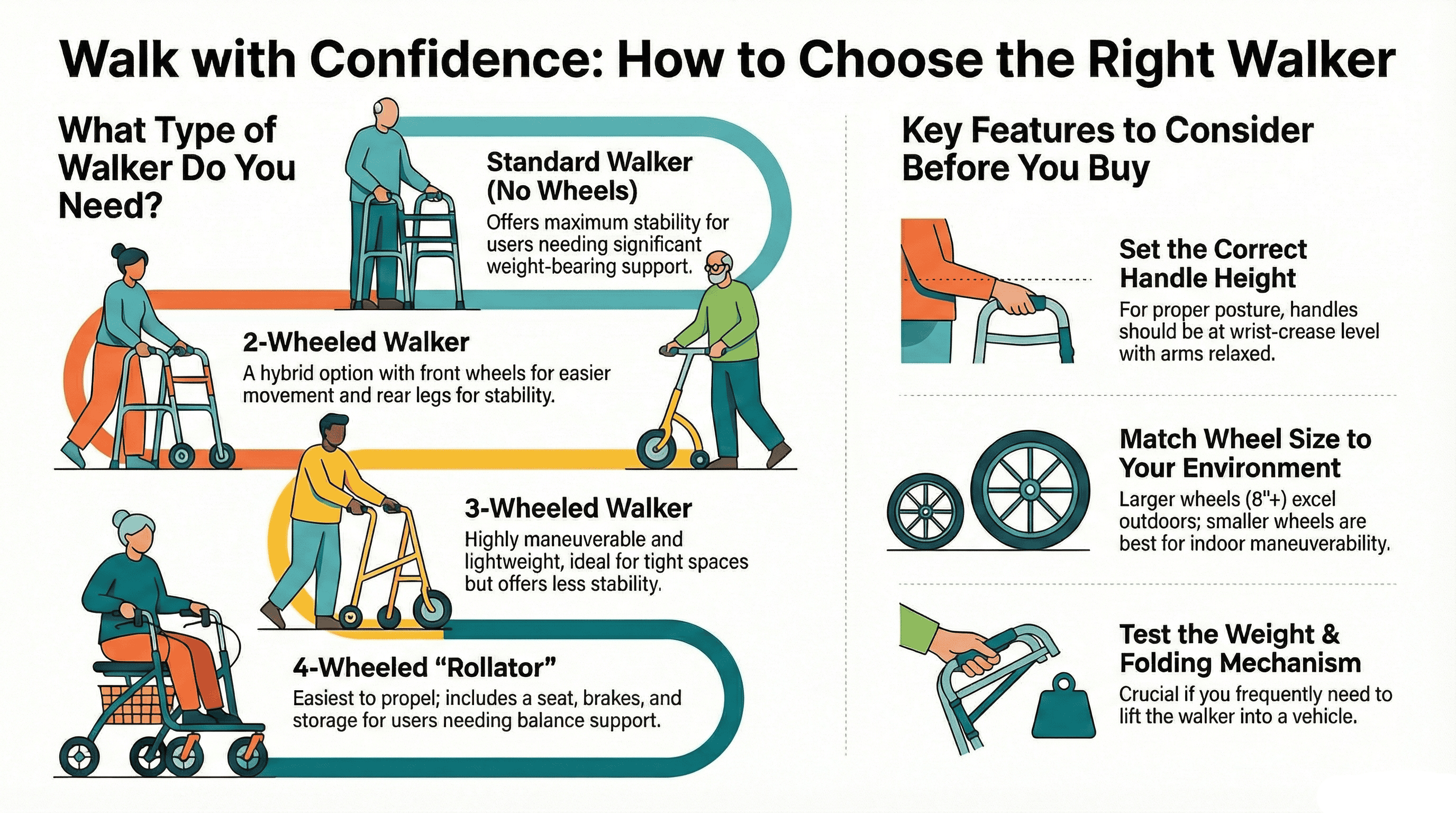
Consider These Key Factors:
Height and Weight: Proper walker fit is crucial for safety. We provide detailed adjustment ranges and weight capacities for every model.
Living Space: Narrow walkers designed for small apartments navigate tight doorways and hallways. Measure your narrowest passage before selecting.
Activity Level: Indoor walkers differ from outdoor models. Active seniors need all-terrain capabilities while others prioritize smooth indoor rolling.
Storage Needs: Consider built-in baskets, trays, and bags. Many seniors use their walker as a mobile table and storage solution.
Budget and Insurance: If a doctor prescribes a walker for use in your home, Medicare Part B can help pay for it. See the Medicare section below.
Does Medicare Cover Walkers and Rollators? (2026)
Yes, in many cases. Medicare Part B covers walkers, including rollators, as durable medical equipment when your doctor prescribes one for use in your home. Here’s how it works in 2026:
- You need a prescription from a doctor or other treating provider enrolled in Medicare.
- You must buy or rent from a supplier enrolled in Medicare. Suppliers that accept assignment can’t charge you more than the Medicare-approved amount.
- After you meet the Part B deductible ($283 in 2026), you typically pay 20% of the Medicare-approved amount.
- Medicare pays for a model that meets your medical need. Extra features, premium styles, or colors are usually out of pocket.
- Medicare Advantage plans also cover walkers, but may require you to use in-network suppliers.
Learn more in our Medicare and insurance guide for walkers and rollators, or check the official Medicare.gov walkers page. Coverage rules can change, so confirm with Medicare or your plan before you buy.
Key Safety Features to Look For
Whichever walker you choose, check for these safety basics:
- Ergonomic Hand Grips: Reduce wrist strain and accommodate arthritis
- Reliable Braking Systems: Hand brakes, foot brakes, or combination systems
- Stability Features: Wide wheelbase, non-slip rubber tips, and weight distribution
- Visibility Enhancements: Reflective strips for low-light safety
- Quality Construction: Aircraft-grade aluminum or reinforced steel frames
Free Tools and Guides
Walker Finder Quiz
Answer a few questions to see which type of walker may fit your needs: take the walker finder quiz.
Walker Handle Height Calculator
Find a starting handle height before you buy or adjust a walker: open the calculator.
Walker Safety Guide
Learn safer ways to handle doorways, curbs, and getting up from a chair: read the walker safety guide.
Mobility and Balance Exercises
Simple exercises that can help build strength and confidence. Check with your doctor or physical therapist first: see the exercises.
Frequently Asked Questions about Walkers for Seniors
A standard walker has four fixed legs that you lift slightly with each step, while a rollator has wheels, hand brakes, and usually a built-in seat for resting.
The correct height usually places the walker handles at wrist level when the senior stands upright with arms relaxed at the sides, allowing a slight bend in the elbows when holding the grips.
A senior may need a walker instead of a cane if there is frequent loss of balance, recent falls, or difficulty putting weight on one or both legs with a single-point support.
Four-wheel rollators are usually more stable and comfortable for outdoor use because they often have wider frames, larger wheels, a seat, and better braking systems.
Walkers and rollators should be checked regularly for worn tips, loose screws, brake issues, or damaged wheels, and replaced or serviced when parts are no longer safe or adjustable to the user’s needs.
Start Your Journey to Better Mobility Today
Your independence matters. Whether you need a walker for a short recovery or long-term support, the best next step is to talk with your doctor or physical therapist about your needs, then compare a few models that fit them.
Ready to Get Started?
- Not sure which type you need? Take the walker finder quiz.
- Ready to compare models? See our best walkers for seniors comparison.
- Using Medicare? Read our Medicare coverage guide.
- Have a question? Contact us.