
Last updated October 2026 · By Walkers4Seniors Editorial Team
Affiliate disclosure: Some links on this page are affiliate links. If you buy through them we may earn a small commission at no extra cost to you. Read our disclosure.
Medical disclaimer: This guide is general information, not medical advice. A physical or occupational therapist can assess your bathroom and show you safe transfers. Ask your doctor for a referral.
Quick answer: To make a bathroom safe for a walker user, install grab bars by the toilet and inside and outside the tub or shower, put a non-slip mat or strips in the tub, sit on a shower chair or tub transfer bench to bathe, raise the toilet seat if standing up is hard (or use a bedside commode for night-time trips), and keep the walker within reach but outside the wet area. CDC data show 81.1% of bathroom injuries are falls.
Why Is the Bathroom So Risky for Seniors?
In 2008, US emergency rooms treated 234,094 nonfatal bathroom injuries in people aged 15 and older, according to a CDC report (MMWR, 2011). Falls caused 81.1% of them. About two thirds (68.3%) happened in or near the tub or shower, and 13.7% of patients were admitted to the hospital.
The risk climbs with age. The injury rate was 112.1 per 100,000 people aged 65–74, 241.0 at ages 75–84 and 515.3 at age 85 and older. At 85 and older, the rate of injuries near the toilet alone was 266.6 per 100,000.
Falls in general are common. The CDC reports that more than 1 in 4 older adults fall each year, and falls lead to about 4.5 million emergency room visits a year in this age group, including 1.4 million hospital stays.
Bathroom Safety Checklist for Walker Users
| Area | Problem | Fix | Source |
|---|---|---|---|
| Tub or shower floor | Slippery when wet | Non-slip rubber mat or self-stick strips inside; non-skid mat outside | CDC STEADI, MedlinePlus |
| Getting in and out of the tub | Stepping over the tub wall | Tub transfer bench + grab bars inside and outside the tub | CDC STEADI, UMass Memorial |
| Standing in the shower | Tiring, risk of losing balance | Shower chair or bench; handheld shower head | MedlinePlus, UMass Memorial |
| Toilet | Hard to sit down and stand up | Raised toilet seat, toilet safety frame or grab bar beside the toilet | CDC STEADI, MedlinePlus |
| Towel bars | Used as a handhold | Never lean on them; they can break. Install real grab bars. | MedlinePlus, UMass Memorial |
| Night trips | Dark path, rushing | Night lights from bed to toilet; fitted non-slip footwear by the bed | CDC STEADI |
| Hot water | Scalds if you can’t move away fast | Water heater at 120°F or lower | MedlinePlus |
| Door | Locked in after a fall | A lock that opens from both sides | UMass Memorial |
Where Should Grab Bars Be Placed in the Bathroom?
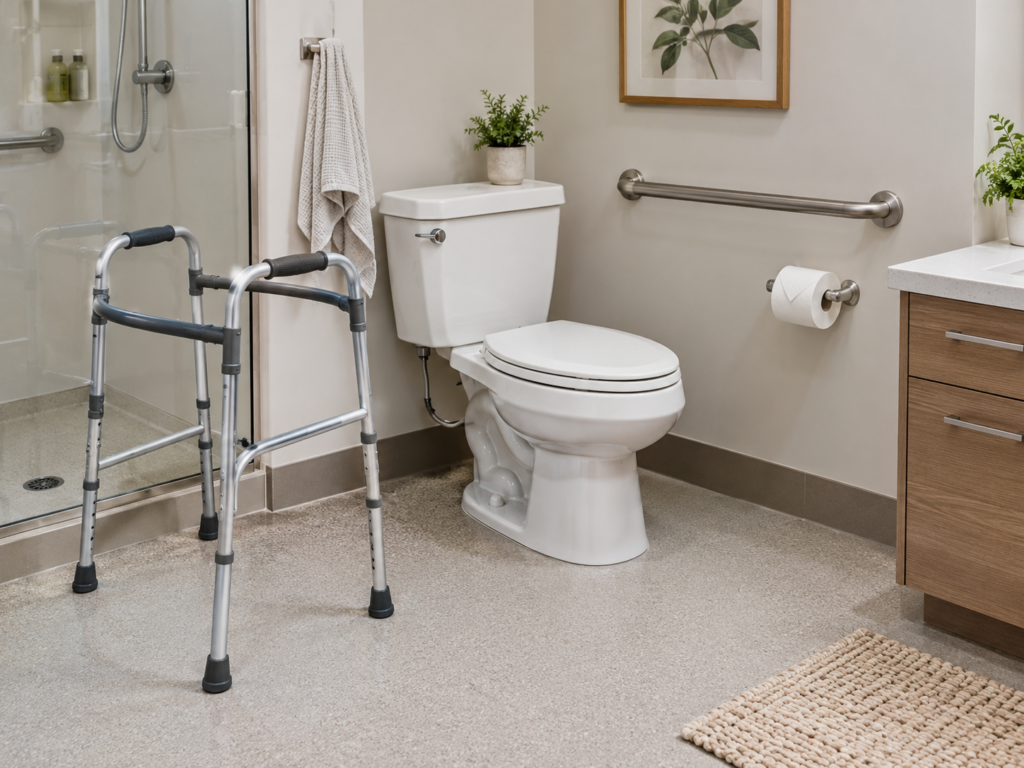
MedlinePlus (from the National Library of Medicine) advises at least two grab bars: one to help you get in and out of the tub and one to help you stand up from sitting. Mount them vertically or horizontally, never diagonally, and screw them into wall studs or approved anchors. Compare 5 models in our guide to the best grab bars for seniors.
For exact heights, many installers use the 2010 ADA Standards. These rules are for public buildings, not homes, but they are a helpful reference:
- Grab bars mounted 33 to 36 inches above the floor, measured to the top of the bar (ADA 609.4).
- Round bars 1¼ to 2 inches in diameter, with a 1½-inch gap from the wall (ADA 609.2, 609.3).
- Each bar holds at least 250 pounds of force (ADA 609.8).
- Beside the toilet: a bar at least 42 inches long, no more than 12 inches from the back wall (ADA 604.5.1).
A therapist can suggest the best spot for your height and the side you are stronger on.
Can You Take a Walker Into the Shower?
Usually not. Most walkers are not made for wet floors. UMass Memorial Health advises keeping the walker “within reach, outside the bathtub” and using a walker made for wet areas only if your therapist recommends one. The safer routine is to walk to the tub or shower with the walker, then sit on a bench or chair to bathe.
How Do You Get Into a Tub Safely With a Walker?
This is the method in UMass Memorial and GBMC patient handouts. Practice it with a therapist or helper first.
- Walk up to the tub transfer bench and turn so the backs of your legs touch it.
- Reach back for the bench or grab bar with one hand, then the other. Do not pull on the walker.
- Sit down slowly and scoot back on the bench.
- Lift one leg, then the other, over the tub wall. Use your hands to help if needed.
- Move the walker to the side, within reach. A handheld shower head lets you wash seated.
- To get out, reverse the steps and use the walker to rise from the bench.
MedlinePlus also says: “Do not pull on or tilt the walker to help you stand up.”
What Is the Difference Between a Shower Chair and a Transfer Bench?
A shower chair sits fully inside the tub or shower. It suits walk-in showers and people who can step in safely. A tub transfer bench straddles the tub wall, with two legs inside and two outside. You sit down outside the tub and slide across, so you never step over the wall. For most walker users with a standard tub, a transfer bench is the safer choice. Compare 6 models in our guide to the best tub transfer benches for seniors, or see the best shower chairs for seniors for walk-in showers.
Bathroom Safety Products for Walker Users: Comparison
| Product | What it does | Key specs (maker/retailer) | Price seen (Oct 2026) |
|---|---|---|---|
| Drive Medical Transfer Tub Bench (12011KD-1) | Slide into the tub seated | 400 lb capacity; seat height 17.5–22.5 in; reversible for either side; suction-cup feet | $61.91 (Vitality Medical) |
| Drive Medical Shower Chair with Folding Back (RTL12606) | Sit to shower | 300 lb capacity; seat height 17–23 in | $72.00 (Walmart) |
| Moen Home Care 24″ Grab Bar (8724 / peened finish) | Handhold by tub or toilet | 24 in long; up to 500 lb when fixed to studs or Moen SecureMount anchors | $32.00–$42.07 (Walmart) |
| Gorilla Grip Bath Tub & Shower Mat | Non-slip tub floor | 35 x 16 in; suction cups; machine washable | $28.99 (Walmart) |
| Raised toilet seat with arms | Easier to sit and stand | Adds 3.5–5 in; most hold 300 lb | See 7 options compared |
Prices change often. Check the current price and weight limit before you buy.
See tub transfer benches on Amazon
Shower chairs with back on Amazon · Moen grab bars on Amazon · Non-slip bath mats on Amazon
Who these are NOT for: Suction-cup grab bars should not be used to hold your body weight; no source we checked supports that. A transfer bench may not fit a small tub or a shower with glass doors, so measure first. If you weigh more than the listed capacity, choose a bariatric model.
Does Medicare Cover Grab Bars, Shower Chairs or Raised Toilet Seats?
Usually not under Original Medicare. Medicare treats most bathroom items as personal convenience items. A CMS policy article states: “A raised toilet seat (E0244) is noncovered.” Bedside commode chairs can be covered as durable medical equipment when medically needed.
Some Medicare Advantage plans do help. Since 2019, CMS has allowed plans to offer bathroom safety devices, such as shower stools, grab bars and raised toilet seats, as a supplemental benefit. Check your plan’s Evidence of Coverage. Read more in our Medicare guide for walkers and rollators.
More Bathroom and Daily-Living Guides
- Best raised toilet seats for seniors: seat heights, arms and safety frames
- Best non-slip slippers and shoes for elderly people: what to wear on night bathroom trips
- Best reacher grabbers for seniors: pick up dropped items without bending
- Walker baskets and bags: carry toiletries with both hands on the walker
- Medical alert systems for walker users: waterproof buttons for the shower
- Where seniors fall most often at home
- Best walkers after hip surgery, including bathroom tips with hip precautions
Not sure how high the fall risk is? Take the free fall risk assessment or the Timed Up and Go test with a helper. Still choosing a walker? Compare the best walkers for seniors.
Frequently Asked Questions
How do you make a bathroom safe for elderly people?
Add grab bars by the toilet and tub, a non-slip mat in the tub, a shower chair or transfer bench, a raised toilet seat if needed, night lights, and keep the water heater at 120°F or lower. A therapist home visit can spot other risks.
Where should grab bars be placed?
At least one bar to get in and out of the tub and one to stand up from the toilet or seat, mounted vertically or horizontally into studs. Public-building ADA rules place them 33 to 36 inches above the floor.
Can you take a walker into the shower?
Most walkers should stay outside the wet area. Walk to the tub or shower, sit on a bench or chair, and keep the walker within reach outside the tub.
What is the difference between a shower chair and a transfer bench?
A shower chair sits fully inside the tub or shower. A transfer bench straddles the tub wall, so you sit down outside the tub and slide in without stepping over the wall.
Does Medicare cover grab bars and shower chairs?
Original Medicare generally treats bathroom safety items as convenience items and does not cover raised toilet seats (E0244). Commode chairs can be covered when medically needed. Some Medicare Advantage plans cover bathroom safety devices as a supplemental benefit.
Are towel bars safe to hold on to?
No. Towel bars are not built to hold body weight and can break. Use grab bars fixed into wall studs.
Sources
- CDC MMWR, Nonfatal Bathroom Injuries Among Persons Aged ≥15 Years — United States, 2008 (2011)
- CDC, Facts About Older Adult Falls
- CDC STEADI, Check for Safety
- MedlinePlus, Bathroom safety for adults and Using a walker
- UMass Memorial Health, Walkers: Bathing
- GBMC, Tub transfer bench handout
- 2010 ADA Standards, 609 Grab Bars and 604 Water Closets
- CMS, Commodes, Bed Pans and Urinals policy article A52461
- CMS, Medicare Advantage supplemental benefits memo (April 27, 2018)