
Maintaining your independence and mobility is a vital part of living a full and active life. As we age, sometimes we need a little extra support to continue moving with confidence. A rollator walker can be a wonderful tool for this, but choosing the right one and understanding how Medicare can help pay for it can seem like a daunting task. This guide is designed to simplify the process, providing a clear, step-by-step path to selecting the perfect rollator for your needs and navigating your Medicare coverage with ease.
——————————————————————————–
1. First, What Exactly is a Rollator Walker?
Before diving into specific features, materials, and payment options, it’s essential to understand the fundamental differences between common mobility aids. Ensuring you start your search in the right category will save time and help you focus on the device that will truly meet your needs and enhance your lifestyle.
1.1. Rollator vs. Standard Walker
While often grouped together, rollators and standard walkers serve different primary purposes and are suited for different users. A rollator is designed to glide, while a standard walker must be lifted with each step.
| Rollator Walker | Standard Walker |
| Wheels: Has three or four wheels and rolls smoothly. | Legs: Has four legs with no wheels (or sometimes two front wheels). |
| Movement: The user pushes the device forward without lifting. | Movement: Requires the user to lift and place the walker forward with each step. |
| Features: Typically includes hand brakes, a built-in seat for resting, and a storage pouch or basket. | Features: A simple frame with handgrips. Does not include a seat or brakes. |
| Ideal User: Best for individuals who have less stamina, need to sit frequently, or require support without having to lift a device. | Ideal User: Best for individuals who need significant weight-bearing support and for use in smaller indoor spaces. |
1.2. When Should You Consider a Rollator?
A rollator may be the right choice if you are beginning to experience certain mobility challenges. Key indicators include facing difficulty placing your full body weight on one or both legs, having light balance challenges, or finding that you need to sit down and rest often while walking. A rollator can provide the support and confidence needed to prevent falls and remain active.
——————————————————————————–
2. How to Choose the Perfect Rollator for Your Lifestyle
A rollator is more than just a mobility aid; it’s a personal tool that will become part of your daily life. The best choice is not a one-size-fits-all solution. It depends on a careful evaluation of your individual needs, your home environment, and your day-to-day activities. This section serves as a practical checklist to help you find a perfect match.
2.1. Material Matters: Analyzing the Frame
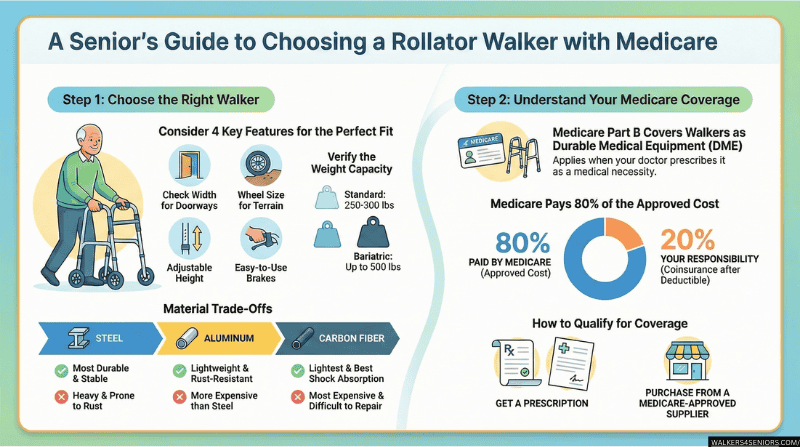
The material of a rollator’s frame determines its weight, durability, and cost. There are three primary options to consider.
- Steel: A very durable and stable option, steel rollators are often the most affordable. However, they are also the heaviest, which can make them difficult to lift and transport. They also require regular care to prevent rust.
- Aluminum: This is the most common material for modern rollators. Aluminum frames are lightweight, rust-resistant, and easy to fold, making them an excellent all-around choice for both indoor and outdoor use and for travel.
- Carbon Fiber: This is the premium option, offering an exceptionally lightweight frame that is five times stronger than steel. Carbon fiber provides excellent shock absorption for a smoother journey but comes at a significantly higher price point and can be difficult to repair if damaged.
2.2. Key Features to Evaluate for Safety and Comfort
Beyond the frame, several critical features will impact your safety, comfort, and the rollator’s overall usability.
Weight Capacity and Portability
Always check the manufacturer’s specified weight limit. Most standard rollators can safely support up to 250-300 pounds. For those who need greater support, bariatric models are available that can hold up to 500 pounds. If your weight is near the 300-pound threshold, it is wise to discuss a bariatric model with your doctor to ensure your prescription accurately reflects your needs for both safety and coverage. Also, consider the rollator’s own weight. A lighter model will be much easier for you or a loved one to fold and lift into a car.
Sizing and Adjustability
Proper sizing is crucial for maintaining good posture and preventing strain. Look for a rollator with adjustable handle heights that allow you to stand upright with a slight bend in your elbows. If the model includes a seat, check if its height is comfortable for you or if it is adjustable. It is also wise to measure the width of the doorways in your home to ensure the rollator can pass through them easily.
Braking Systems
Brakes are a critical safety feature on any rollator. The most common type is loop brakes, which are engaged by squeezing a lever. These can sometimes be difficult for users with arthritis or hand weakness. An alternative is push-down brakes, which require less grip strength and force to operate. Choose a system that you can engage confidently and comfortably.
Wheels and Terrain
The size of a rollator’s wheels affects how it handles different surfaces. Smaller wheels are often sufficient for smooth, indoor floors. However, larger wheels, typically 8 inches or more, are much better for navigating rough or uneven outdoor terrain, such as grass, gravel, or thick carpets.
Essential Accessories
Many rollators come with built-in features that add significant convenience. Look for models that include a padded seat and a backrest for comfortable resting, as well as an under-seat storage basket or pouch to securely carry personal items like a purse, groceries, or a book.
——————————————————————————–
3. Does Medicare Cover Rollator Walkers?
This is one of the most common and important questions for seniors considering a mobility aid. The short answer is yes, Medicare can help cover the cost of a rollator walker. However, this coverage is not automatic and depends on meeting specific rules and definitions set by Medicare, which this section will clarify.
3.1. Walkers as “Durable Medical Equipment” (DME)
Medicare Part B (Medical Insurance) helps pay for a category of items called Durable Medical Equipment, or DME. This category includes equipment like wheelchairs, hospital beds, and, importantly, walkers and rollators. Because rollators fall under the definition of DME, they are eligible for coverage under Part B.
3.2. The “Medically Necessary” Requirement
For Medicare to cover your rollator, one critical condition must be met: it must be deemed “medically necessary.” This means that a Medicare-enrolled doctor must determine that the rollator is required to help with your medical condition and must order it for your use in your home. It’s important to note that the features of your chosen rollator should align with your documented needs for use inside your home. While a model with large, outdoor wheels might be appealing, your doctor’s prescription must justify its necessity for your daily activities within your home environment to ensure coverage.
——————————————————————————–
4. Your Step-by-Step Guide to Getting a Rollator with Original Medicare
Knowing that Medicare can cover a rollator is the first step. This section provides an actionable plan with the exact steps you need to follow to make it happen if you have Original Medicare (Part A and Part B).
Step 1: Get a Prescription from Your Doctor
Your journey begins with a visit to your doctor. During this appointment, the doctor will assess your mobility needs. If they determine that a rollator is medically necessary for you, they must document this need in your medical record and provide you with a written order, or prescription, for the device.
Step 2: Find a Medicare-Approved DME Supplier
You cannot purchase a rollator from just any store. To use your Medicare benefits, you must get the rollator from a medical equipment supplier that is enrolled in the Medicare program. It’s crucial to confirm this with the supplier before you rent or buy the equipment. As shown on a standard Medicare card, this coverage falls under your MEDICAL (PART B) benefits.
Step 3: Understand Your Costs and “Assignment”
Under Original Medicare Part B, you are responsible for some out-of-pocket costs. First, you must meet your annual Part B deductible. After the deductible is met, Medicare typically pays 80% of the approved amount for the rollator. You are responsible for the remaining 20% coinsurance.
To keep your costs as low as possible, you should always use a supplier that “accepts assignment.” This is a critical term to understand. Assignment means the supplier agrees to accept the Medicare-approved amount as full payment. They can only bill you for your Part B deductible and the 20% coinsurance.
Be aware that some suppliers are “non-participating” and do not accept assignment. These suppliers can charge you more than the Medicare-approved amount—a practice known as the “limiting charge,” which can be up to 15% higher. This means your final bill could be significantly more than the standard 20% coinsurance. Always ask a supplier, “Do you accept assignment for this rollator?” before you proceed to avoid any unexpected and costly surprises.
——————————————————————————–
5. Navigating Coverage with a Medicare Advantage (Part C) Plan
If you are enrolled in a Medicare Advantage (Part C) plan, you have a different path to getting your rollator covered. These plans are offered by private insurance companies, and while they are required by law to cover everything that Original Medicare covers (including rollators), they have their own set of rules for how you get that coverage.
Key Differences to Be Aware Of
When using a Medicare Advantage plan, be mindful of these key differences compared to Original Medicare:
- Provider Networks: Your plan will likely have a network of approved doctors and DME suppliers. To get the lowest out-of-pocket costs, you will need to get your prescription from an in-network doctor and obtain your rollator from an in-network DME supplier.
- Prior Authorization: Many Medicare Advantage plans require prior authorization, or pre-approval, before they will cover a rollator. This means the plan must review your doctor’s order and agree that the equipment is necessary before you get it.
- Your Costs: Your out-of-pocket costs may be different. Instead of a 20% coinsurance, you might pay a fixed copayment for your rollator. Advantage plans also have a yearly limit on your total out-of-pocket costs, which Original Medicare does not have.
Your best first step is to call the member services number on the back of your plan ID card. The plan representative can explain the specific steps, costs, and network requirements for getting your rollator.
——————————————————————————–
6. Other Ways to Manage Rollator Costs
Even with excellent Medicare coverage, out-of-pocket expenses like deductibles and coinsurance can add up. Fortunately, there are other resources available to help manage these costs.
Using Medigap and Other Resources
If you have Original Medicare, a Medicare Supplement Insurance (Medigap) policy can be very helpful. These private insurance plans are designed to fill the “gaps” in Original Medicare by paying for costs like your 20% coinsurance for Durable Medical Equipment.
For those who may be paying for a rollator entirely out-of-pocket, many models are eligible for purchase using funds from a tax-advantaged Health Savings Account (HSA) or Flexible Spending Account (FSA). Finally, never forget the free, personalized counseling available from your State Health Insurance Assistance Program (SHIP). A trained SHIP counselor can answer your specific questions about Medicare coverage and costs in your state.
——————————————————————————–
7. Conclusion: Walking Forward with Confidence
Choosing a rollator walker is a proactive and empowering step toward maintaining your mobility and freedom. By carefully considering the features that match your lifestyle—from the frame material to the wheel size—you can find a device that feels like a natural extension of yourself. Just as importantly, understanding how Medicare works removes the financial uncertainty from the process. Whether you have Original Medicare or a Medicare Advantage plan, you have a clear path to getting the support you need. Armed with this knowledge, you can walk forward into your next chapter with stability, safety, and confidence.