
TL;DR – Walker Adjustment Essentials
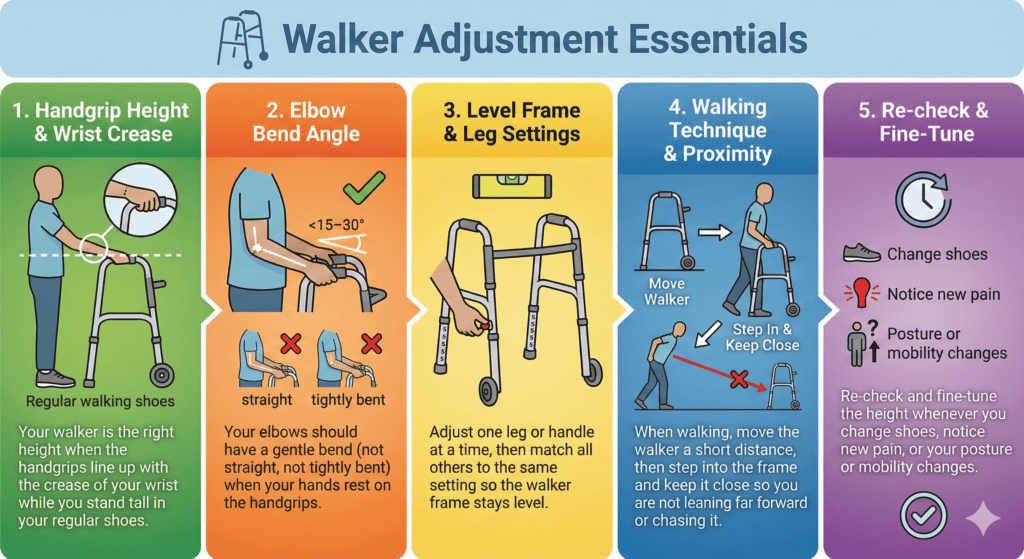
- Your walker is the right height when the handgrips line up with the crease of your wrist while you stand tall in your regular shoes.
- Your elbows should have a gentle bend (not straight, not tightly bent) when your hands rest on the handgrips.
- Adjust one leg or handle at a time, then match all others to the same setting so the walker frame stays level.
- When walking, move the walker a short distance, then step into the frame and keep it close so you are not leaning far forward or chasing it.
- Re‑check and fine‑tune the height whenever you change shoes, notice new pain, or your posture or mobility changes.
Intro
How to adjust a walker correctly is one of the most important safety steps for seniors using mobility aids.Many seniors are given a walker but never shown exactly how to adjust it or use it safely. Search data shows thousands of people asking how high a walker should be, how to adjust the legs, and what good posture looks like. This guide explains, step by step, how to set the correct height, fit the walker to your body, and use it confidently at home and outdoors.
Why proper walker adjustment matters
Explain the “why” briefly.
- A walker that is too low makes people hunch over, which can cause back, neck, and shoulder pain and increase fall risk.
- A walker that is too high forces the shoulders up and the elbows straight, making it harder to control and more likely to slip away.
- Correct height and posture help keep weight centered between the legs and the frame, so every step feels more stable and less tiring.
How to know if your walker is the wrong height
Use clear signs to match common queries like “what happens if a walker is too high” and “improper walker position”.
- Signs your walker is too low:
- You feel bent forward or hunched, looking down at the floor.
- Your back or neck hurts after even short walks.
- Signs your walker is too high:
- Your shoulders feel lifted and tense, and you must almost reach up to the handgrips.
- Your elbows are nearly straight, and the walker feels like it is pulling you instead of supporting you.
- Signs the frame is uneven:
- One wheel or leg touches the floor before the others, or the walker “rocks” when you put weight on it.
- You feel like it pulls to one side or one front wheel lifts off when you turn.
How to measure for the correct walker height
Target queries like “how to measure walker height”, “height of walker”, “how high should a walker be”.
- Step 1 – Stand in your normal shoes:
- Stand up straight inside or beside the walker, with shoulders relaxed and arms hanging naturally at your sides.
- Step 2 – Check wrist crease level:
- Look at the crease on the inside of your wrist where your hand meets your arm.
- The top of the handgrip should line up with that wrist crease when your arms hang relaxed.
- Step 3 – Check elbow bend:
- Place your hands on the grips and stand tall.
- Elbows should bend slightly, not straight and not sharply bent; a gentle bend gives control and comfort.
Mention your calculator:
- You can also use the Walker Handle Height Calculator on this site to estimate starting height based on your body measurements, then fine‑tune using the steps above.
Step‑by‑step – how to adjust a standard walker
Target “how to adjust a walker”, “how to adjust walker height”, “walker adjustment for height”, “how to adjust walker correctly”.
- Before you start:
- Make sure the walker is on a flat surface.
- Locate the push‑button pins or knob holes on each leg.
- Steps to adjust:
- Step 1: Stand inside the frame in your regular shoes using the measuring steps above to decide the right height.
- Step 2: Adjust the first front leg so the handgrip is at wrist‑crease level, then note the hole number or marking.
- Step 3: Adjust the other front leg to the same setting so the front of the frame is level.
- Step 4: Adjust the back legs to match the same hole number or marking as the front legs.
- Step 5: Test the walker by stepping inside, taking a few small steps, and checking that all feet or wheels touch the floor together.
Add short safety note:
- Never pull just one leg up or down without matching the others, because an uneven walker can catch on carpets or thresholds and cause falls.
How to adjust a rollator or walker with wheels
Target “adjusting rollator walker handles”, “drive walker height adjustment”, “rollator walker height instructions”.
- Handle height adjustment:
- Most rollators have a knob or screw at the side of each handle; loosen, slide the handle up or down, then retighten firmly.
- Use the same wrist‑crease and elbow‑bend checks to confirm height is correct on both sides.
- Seat height and safety:
- Follow the manufacturer’s manual when changing seat height so the brakes and cables still work correctly.
- After any adjustment, test sitting and standing several times with someone nearby to confirm stability.
Proper body position and posture when using a walker
Target queries like “how your body should be angled to use a walker”, “proper walker height”, “proper way to adjust height of a walker”.
- Standing posture:
- Stand tall with ears over shoulders, shoulders over hips; avoid leaning far forward over the frame.
- Keep hands relaxed on the grips, not squeezing too tightly.
- Walking pattern:
- Move the walker a short distance ahead, then step into the frame with the weaker or more painful leg first.
- Keep your feet between the back legs or wheels, not behind them or too far ahead of the front bar.
- Turning and stopping:
- Turn using several small steps rather than twisting your back while the walker stays still.
- Before sitting down, back up until you feel the chair behind your legs, then turn and sit slowly while holding the armrests if available.
Common mistakes and how to fix them
Map to queries about “improper walker position”, “patient finds walking with a walker goes too fast”, and “keep banging my leg on walker”.
- Pushing the walker too far ahead:
- Problem: the walker starts to “run away” and the user feels like they are chasing it.
- Fix: take smaller steps and keep the front bar only a short distance ahead of the toes.
- Walking outside the frame:
- Problem: feet stay behind the back legs, which reduces support and can cause tripping.
- Fix: focus on stepping into the middle of the frame so weight stays inside the base.
- Hitting shins or legs on the frame:
- Problem: legs hit the bar because the walker is too low or steps are too long.
- Fix: raise the height slightly and shorten steps so the walker moves first, then the feet follow.
- Uneven legs or wheels:
- Problem: one corner lifts or catches, especially on carpets or outdoor surfaces.
- Fix: re‑check all leg settings and make sure they match, then test on a flat floor before using on uneven ground.
When and how often to re‑check your walker
Align with “when should I adjust the height of my walker” and similar queries.
- Re‑check height if:
- You change to thicker or thinner shoes or start using house shoes instead of outdoor shoes.
- You notice new pain in back, shoulders, or wrists, or feel less stable when walking.
- Who can help:
- Physical therapists, occupational therapists, and trained staff at many clinics or mobility stores can confirm your adjustment and suggest changes.
- Ask them to show you or a caregiver how to adjust the walker so you can repeat it at home when needed.
When a different walker might be safer
You have many queries about tall users, heavy users, and balance issues.
- Height and body size:
- Very tall or very short people may need models designed specifically for their height range to get correct arm position.
- People over a certain weight limit should use bariatric walkers with a stronger frame and wider base for safety.
- Balance and lifestyle:
- Users with serious balance problems may be safer with a standard walker or a model recommended by a therapist rather than a fast‑rolling rollator.
- People walking mostly outdoors may benefit from larger wheels and more stable designs to handle uneven ground.
Add internal link prompts in your editor to your existing posts about tall walkers, bariatric walkers, and balance problems.
Walker Height & Adjustment – FAQ
Resources
Walker Handle Height Calculator
Tall Walkers for Seniors: The Ultimate Guide
Visit our complete Walker Safety Guide page. 📥 Download our comprehensive free guide: Walker Confidence and Independence – Complete Safety & Mobility Guide (PDF) – Learn how to choose the right walker, adjust it perfectly, master safe walking techniques, prevent falls, and create a walker-friendly home.
For more information about walker safety and proper use, visit the CDC fall prevention guidelines or consult with a physical therapist.