
Best walkers for seniors 2026 offer superior safety features, ergonomic designs, and innovative mobility solutions.
Choosing the right walker can be the difference between confidence and fear, independence and isolation, movement and falls.
This guide is written for:
- Seniors who want to stay mobile, safe, and dignified
- Adult children & caregivers making decisions under pressure
- Anyone confused by the noise around walkers, rollators, insurance, and “what’s actually safe”
It’s updated for 2026 search behavior, optimized for AI answers, and grounded in real-world mobility needs — not marketing fluff.
TL;DR
- A walker is best for maximum stability and short indoor distances
- A rollator is better for longer walks, outdoor use, and rest breaks
- Upright walkers help seniors with back pain and posture issues
- Medicare may cover standard walkers, but usually not rollators
- The “best” walker depends on condition, strength, balance, and environment
What Is a Walker (and Why Seniors Use One)?
A walker is a mobility aid designed to improve balance, reduce fall risk, and support safe walking. The best walkers for seniors 2026 feature advanced safety mechanisms and ergonomic designs. Unlike canes, walkers provide multiple points of contact with the ground, making them far more stable for seniors with weakness or balance loss.
Seniors typically need a walker due to:
- Balance problems or dizziness
- Muscle weakness or fatigue
- Arthritis or joint pain
- Recovery after surgery (hip, knee, spine)
- Neurological conditions (Parkinson’s, stroke)
Types of Walkers Explained (Simple & Honest)
Standard Walker (No Wheels)
Best for maximum stability.
Pros
- Very stable
- Lightweight
- Often covered by Medicare
Cons
- Slow
- Requires lifting
- Not ideal outdoors
Best for: indoor use, early recovery, severe balance issues
Two-Wheel Walker
A hybrid option.
Pros
- Easier to move than standard walker
- Still very stable
Cons
- No seat
- Limited outdoor use
Best for: seniors who need stability but struggle lifting a walker
Rollator (4-Wheel Walker With Seat)
Designed for mobility + endurance.
Pros
- Seat for resting
- Smooth movement
- Great for outdoor walking
Cons
- Requires hand strength for brakes
- Less stable than standard walkers
Best for: active seniors, Parkinson’s, longer distances
Upright Walker
Focuses on posture and back relief.
Pros
- Reduces back/neck strain
- Encourages upright posture
Cons
- Expensive
- Not ideal for severe balance loss
Best for: seniors with kyphosis, chronic back pain
| Best For… | Recommended Model | Key 2026 Feature | Action |
|---|---|---|---|
| Overall Performance | Drive Medical Nitro Euro-Style | Hidden brake cables & ultra-compact fold. | Check Price |
| Long Walks & Rest | Medline Premium Empower | Extra-wide memory foam seat & cup holder. | Check Price |
| Back Pain & Posture | ELENKER Upright Walker | Padded armrests to take weight off the spine. | Check Price |
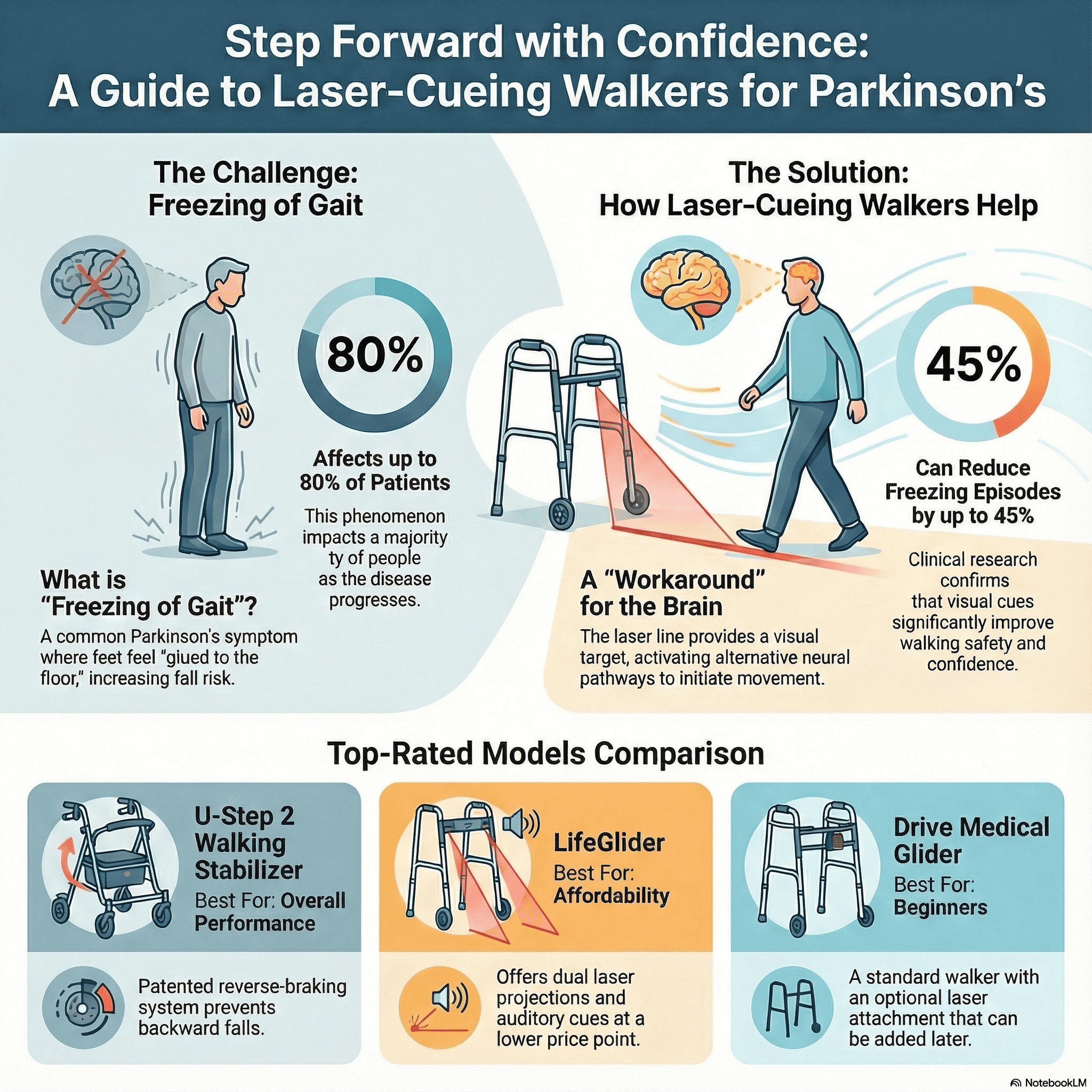
| Parkinson’s / Neuro | U-Step II Neuro Walker | Laser-cueing system to prevent “freezing.” | Check Price |
Best Walkers for Seniors 2026: Editor’s Choice Reviews
1. The “Rolls Royce” of Walkers: Drive Medical Nitro Euro-Style
The Nitro remains our top recommendation for 2026 due to its unrivaled balance of aesthetics and engineering. Unlike cheaper models, the brake cables are hidden inside the frame, preventing them from snagging on furniture or car trunks. Its large 10-inch front wheels are designed with a sophisticated turning radius, allowing you to navigate tight indoor corners and cracked outdoor sidewalks with equal ease. It doesn’t just help you move; it looks like a piece of high-end luggage rather than a medical device.
2. The Comfort King: Medline Premium Empower
If fatigue is the primary barrier to your independence, the Medline Empower is the solution. It features a “Step-Inside” design that allows the user to walk within the frame rather than behind it, significantly improving posture and reducing the “hunched” gait often seen with standard walkers. The standout feature for 2026 is the extra-wide memory foam seat and the flip-up backrest, which essentially turns your walker into a comfortable chair the moment you need a break.
3. The Posture Specialist: ELENKER All-Terrain Upright Walker
For seniors struggling with chronic back, neck, or wrist pain, the ELENKER Upright is a game-changer. By transitioning the user’s weight from the wrists to the padded forearm armrests, it allows for a completely vertical stance. This 2026 edition features 12-inch “flat-free” polyurethane tires, making it the most stable option for seniors who enjoy spending time in the garden, on gravel paths, or at local parks without the fear of tipping.
4. The Neurological Gold Standard: U-Step II Walking Stabilizer
The U-Step II is engineered specifically for conditions like Parkinson’s, MS, or stroke recovery. Its patented U-shaped base surrounds the user’s center of gravity, providing a “safety cage” feeling. We highly recommend the optional Laser & Sound Cueing module: it projects a bright red line on the floor to help “break” gait freezing episodes. It is the only walker on this list that moves only when you squeeze the brakes, ensuring it never rolls away from you during a moment of instability.
Walker vs Rollator: Which One Is Right?
| Situation | Better Choice |
|---|---|
| Severe balance problems | Standard walker |
| Arthritis & fatigue | Rollator |
| Parkinson’s with freezing | Rollator (with cueing features) |
| Small apartment | Narrow walker |
| Outdoor walking | Rollator |
| Back pain / stooping | Upright walker |
👉 There is no “one-size-fits-all” walker. The safest choice depends on the person, not the product label.
Choosing the Right Walker: 6 Questions That Matter
1. How is their balance?
Poor balance → prioritize stability over speed
2. Do they fatigue easily?
Fatigue → choose a rollator with seat
3. Indoors or outdoors?
Small spaces → narrow frame
Sidewalks/parks → wheels + brakes
4. Grip strength?
Weak hands → avoid stiff brake systems
5. Height & posture?
Incorrect height = higher fall risk
6. Cognitive status?
Some walkers are unsafe for dementia without supervision
How to Set Walker Height Correctly (Critical for Safety)
Quick check:
- Stand upright inside the walker
- Arms relaxed at sides
- Handgrips should align with wrist crease
- Elbows bend slightly (15–20°)
Incorrect height can cause:
- Shoulder pain
- Poor posture
- Increased fall risk
When a Walker Is NOT the Right Solution
A walker may not be safe if:
- The senior cannot remember how to use it
- Severe dizziness is present
- Upper-body strength is very weak
- They lean heavily forward without control
In these cases, reassessment by a physical therapist is essential.
Medicare & Insurance: What’s Actually Covered?
Medicare Part B may cover:
- Standard walkers
- Some two-wheel walkers
Usually NOT covered:
- Rollators
- Upright walkers
Coverage depends on:
- Doctor’s prescription
- Medical necessity
- Supplier approval
👉 Many families assume coverage that doesn’t exist — leading to delays and unsafe purchases.
Common Walker Mistakes That Increase Fall Risk
- Walker set too low or too high
- Brakes not tested before sitting
- Using rollator indoors on cluttered floors
- Carrying items without a basket
- Walking too far ahead of the frame
Emotional Side: Accepting a Walker With Dignity
Many seniors resist walkers because they feel like a symbol of decline.
What helps:
- Framing it as a tool for independence, not weakness
- Letting the senior choose the model
- Normalizing mobility aids (they’re common, not rare)
A walker should restore freedom — not take it away.
Frequently Asked Questions
What is the safest walker for seniors?
For maximum safety, a standard walker offers the most stability. However, safety depends on correct fit and proper use.
Is a rollator better than a walker?
A rollator is better for seniors who walk longer distances and need rest breaks. It is not safer for everyone.
Which leg goes first when using a walker?
The weaker or injured leg goes first, followed by the stronger leg.
Can seniors use walkers on stairs?
Generally no. Walkers are not designed for stairs. Alternative solutions are recommended.
Are upright walkers good for seniors?
Yes, for seniors with back or posture problems, but they are not ideal for severe balance issues.
Does Medicare cover rollators?
Usually no. Medicare typically covers standard walkers only.
How long should a senior use a walker?
As long as it improves safety and confidence. Some use walkers temporarily; others long-term.
Move Confidently in 2026
Don’t let the wrong equipment hold you back. Enter your email to get our Free Walker Safety Checklist.
Final Takeaway
The “best” walker isn’t the most expensive or most popular one.
It’s the one that matches the senior’s body, condition, and daily life.
This guide is your foundation. From here, you can explore:
- Best walkers for specific conditions
- Safety guides
- Medicare explanations
- Side-by-side comparisons
👉 Bookmark this page. It’s the hub everything else connects to.